Buying an Adult Diaper Direct From Factory can reduce costs, but the lowest quotation is rarely the complete answer. In 2026, professional buyers must examine materials, absorbency, production capacity, quality controls, and delivery reliability. A factory may offer excellent pricing while providing weak samples or unclear specifications. That mistake becomes expensive quickly.
According to Michael R. Hayes, an independent hygiene-product sourcing consultant with over 18 years of factory-audit experience, “A dependable supplier proves quality before discussing volume.” His advice reflects a practical reality. Request several samples first. Check the elastic edges, adhesive strength, odor control, leakage protection, and skin-contact softness. Place samples on a testing table, then examine them after several hours of use. Small details matter.
Factory communication also deserves close attention. Ask for product dimensions, core structure, absorbency data, packaging options, minimum order quantities, and production timelines. Confirm whether the quoted price includes packaging, inspection, and shipping. A factory-direct deal is not automatically transparent. Sometimes, the buyer assumes too much.
This guide explains how to compare manufacturers, verify their capabilities, and negotiate with fewer surprises. It also considers private-label production, sustainable materials, payment protection, and quality documentation. Some recommendations may not fit every market. That is worth admitting. Buyers should adjust their decisions according to user needs, budget, regional requirements, and practical storage conditions. A trustworthy factory relationship develops through evidence, clear records, and repeated communication—not one attractive price.
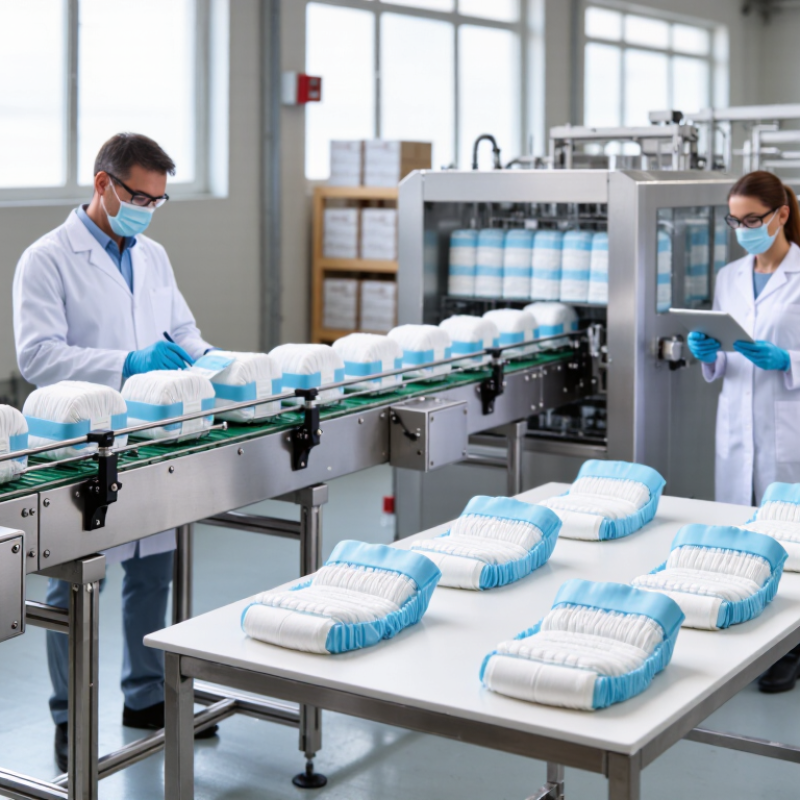
Define Your Adult Diaper Product Requirements for 2026
Defining your adult diaper requirements for 2026 should begin with the user, not the factory catalogue. Specify waist range, absorbency target, daytime or overnight use, and wearing duration. A caregiver may need a breathable product for eight hours, while a mobile user may value thinner materials and stronger side panels. Write these needs in measurable terms.
Request samples before discussing large quantities. Check the core, top sheet, backsheet, leg cuffs, and fastening tabs by hand. Pour measured liquid onto each sample, then inspect leakage after movement. Do not judge absorbency from marketing language alone. In my sourcing work, a softer sample sometimes performed worse during overnight testing. That detail changed the specification.
Prepare a factory-ready sheet with dimensions, material preferences, packing method, carton size, and acceptable defects. Include tolerance ranges, because production is rarely perfect. Ask for test records, quality-control procedures, production capacity, lead time, and sample approval steps. Confirm whether the factory can maintain the same materials across repeat orders. A low minimum order can seem attractive, but inconsistent output creates hidden costs. I would also reserve space for revision notes. Your first requirements may be incomplete. Real user feedback often exposes problems that a clean spreadsheet misses. Keep those findings visible before signing a purchase agreement.
Find and Verify Qualified Adult Diaper Factories
How to Buy Adult Diapers Direct From Factory in 2026?
Finding a qualified adult diaper factory requires more than comparing online prices. Search for manufacturers with stable production lines, export experience, and clear contact details. Request their business registration, factory address, product specifications, and recent quality records. Ask for evidence. A video call can reveal useful details, such as raw material storage, packing conditions, and whether workers follow consistent inspection procedures.
Order samples from the same production line used for bulk orders. Check absorbency, rewet, odor control, waistband comfort, adhesive strength, and leakage after movement. Measure the core weight and inspect the inner layer under bright light. Test several sizes, not only one sample. Request reports for applicable safety and quality standards, then verify them with the issuing organization when possible. A document alone proves little.
A reliable factory should explain its minimum order quantity, lead time, carton dimensions, replacement policy, and quality-control checkpoints in writing. Use a pre-shipment inspection before releasing the final payment. Independent inspection costs money, but defective cartons cost more. Do not rely only on polished videos or fast replies. A factory may pass an online review yet fail during peak production. No checklist is perfect. Leave room for rechecking materials, sample differences, and unexpected delays. A careful buyer also compares the approved sample with packed goods before accepting delivery.
Compare Pricing, Certifications, MOQs, and Production Capacity
How to Buy Adult Diapers Direct From Factory in 2026?
Buying adult diapers directly from a factory requires more than requesting the lowest price. In my sourcing experience, pricing changes with absorbency, materials, packaging, order volume, and shipping terms. Ask for a detailed quotation with unit cost, tooling fees, samples, and payment conditions. Confirm whether the price includes customized printing or only standard packaging. A cheap quote can hide important costs.
Certifications deserve careful checking. Request current test reports, quality certificates, and factory audit records. Verify the testing laboratory, issue date, product scope, and applicable market requirements. Do not rely on certificate images alone. Contact the issuing body when possible. Inspect sample diapers for leakage control, softness, odor, adhesive strength, and sizing accuracy. My first comparison focused too heavily on absorbency figures. That was a mistake. User comfort also affects repeat orders.
Minimum order quantities can vary by size, packaging design, and material selection. Ask whether mixed sizes are allowed within one purchase order. Also confirm lead times for samples, mass production, and repeat orders. Production capacity should include daily output, available shifts, machine numbers, and current workload. Request recent production evidence, not only a claimed monthly figure. A factory may have high capacity but limited availability. Discuss quality control checkpoints, replacement policies, and inspection before shipment. Leave room for delays. Factories, like buyers, sometimes estimate too confidently.
How to Buy Adult Diapers Direct From Factory in 2026?
Indicative factory-direct planning benchmarks for pricing, MOQs, certifications, and production capacity
Larger orders generally reduce the estimated unit price but require higher MOQs and longer production planning. Before placing an order, buyers should verify ISO 9001 or ISO 13485 certification where applicable, product test reports, absorbency results, packaging requirements, and the factory’s confirmed monthly capacity.
Order Samples and Evaluate Product Quality
How to Buy Adult Diapers Direct From Factory in 2026?
Order Samples and Evaluate Product Quality
Buying adult diapers directly from a factory starts with sample orders, not price negotiations. Request several sizes, absorbency levels, and fastening styles from the same production line. Ask for the material list, product specifications, and recent quality-control records. A reliable factory should explain its testing methods clearly.
Handle each sample in realistic conditions. Check the waistband stretch, side gathers, adhesive strength, and softness against the skin. Pour measured liquid into the core, then inspect leakage, surface dryness, and absorption speed. Weigh the dry and used products for a simple absorption comparison. Record results in a table.
Do not trust appearance alone.
My first sample review focused too much on softness. I missed weak side seams that failed after movement. That mistake changed my inspection process. Test products while walking, sitting, and lying down. Ask whether the factory can keep the same materials during mass production. Small changes can affect comfort and protection.
Check packaging strength before placing a larger order. Drop sealed cartons from a low height and inspect crushed corners or broken seals. Confirm production dates, storage guidance, and labeling details. Independent laboratory testing can support claims about absorbency and skin-contact safety. Keep written sample results, factory replies, and approved specifications together. This record helps resolve quality differences later.
How to Buy Adult Diapers Direct From Factory in 2026? - Order Samples and Evaluate Product Quality
Sample evaluation checklist and practical acceptance benchmarks for adult diaper procurement
| Evaluation Area |
Quality Metric |
Sample Test Method |
Recommended Acceptance Benchmark |
Sample A Result |
Sample B Result |
Decision |
| Fit and Sizing |
Waist measurement accuracy |
Measure the relaxed and extended waist with a soft tape; compare with the size chart. |
Actual measurement within ±5% of the approved specification. |
Within ±3% |
Within ±8% |
Sample A |
| Absorption |
Total absorption capacity |
Weigh the dry product, add synthetic urine in measured portions, allow absorption, then weigh again. |
At least 1,800 g for an overnight-oriented adult brief, unless a different specification is agreed. |
1,940 g |
1,680 g |
Sample A |
| Rewet Control |
Surface rewet after absorption |
After liquid absorption, place a pre-weighed absorbent paper stack on the core under a fixed load and reweigh it. |
Not more than 2.0 g transferred moisture under the agreed test conditions. |
1.2 g |
2.7 g |
Sample A |
| Leakage Protection |
Standing and side leakage |
Apply the agreed liquid volume while the product is flat and standing; inspect leg cuffs and side panels. |
Zero visible leakage in three repeated tests at the agreed loading level. |
0 of 3 tests |
1 of 3 tests |
Sample A |
| Core Construction |
Absorbent core distribution |
Cut open three products and inspect pulp and superabsorbent distribution across the front, center, and back zones. |
No exposed gaps, hard clumps, or loose absorbent material; core remains centered. |
Uniform; no gaps |
Slight center clumping |
Sample A |
| Materials and Skin Comfort |
Top-sheet softness and surface condition |
Inspect by hand and under bright light for rough fibers, holes, adhesive residue, or visible contamination. |
Soft, dry, intact surface with no visible foreign matter or irritating residue. |
Soft and intact |
Minor adhesive residue |
Sample A |
| Fasteners |
Tab peel and re-fastening performance |
Open and refasten each tab five times; check attachment, tearing, and loss of grip. |
All tabs remain functional with no tearing after five cycles. |
5 of 5 passed |
4 of 5 passed |
Sample A |
| Elastic Components |
Leg cuff and waistband recovery |
Stretch the elastic to the stated maximum and inspect recovery, breakage, and skin-marking risk. |
No breakage; elastic returns smoothly without excessive tension or loose sections. |
Smooth recovery |
One loose section |
Sample A |
| Breathability |
Backsheet air permeability |
Request the material specification or compare laboratory air-permeability results from the same production lot. |
Use a breathable backsheet with documented test results and no visible film defects. |
Specification provided |
Specification pending |
Sample A |
| Odor and Cleanliness |
Unusual odor and visible contamination |
Open samples in a clean area and inspect immediately and after 24 hours in sealed packaging. |
No strong chemical odor, mold odor, stains, insects, or foreign particles. |
No unusual odor |
Slight chemical odor |
Sample A |
| Packaging |
Carton and inner-pack protection |
Check sealing, moisture protection, carton compression, count accuracy, and lot identification. |
Sealed, dry, undamaged, correctly counted, and traceable by lot or production date. |
All requirements met |
Carton label incomplete |
Sample A |
| Factory Order Readiness |
Specification consistency and production controls |
Request the approved specification sheet, pre-production sample, batch inspection record, lead time, MOQ, and corrective-action process. |
Written specifications, lot traceability, inspection records, and agreed quality limits before mass production. |
Documents available |
Documents incomplete |
Sample A |
Suggested sample quantity
Request at least 5 units per size and absorbency level, preferably from the same production lot.
Approval rule
Approve only when critical tests pass and the factory confirms that mass production will follow the signed sample specification.
Important note
The benchmarks are practical purchasing targets; final requirements should match the destination market and applicable regulations.
Finalize Contracts, Payments, Manufacturing, and Shipping Terms
How to Buy Adult Diapers Direct From Factory in 2026?
Buying adult diapers directly from a factory requires more than comparing unit prices. I begin by checking production experience, export records, quality certificates, and audit reports. Request current samples, not old showroom pieces. Test absorbency, rewet, leakage control, softness, odor, and adhesive strength. Measure each sample against your required size chart. Small differences matter.
Put every agreed detail into the contract. Specify materials, core weight, elastic placement, packaging, labeling, tolerances, and acceptable defect rates. Include production lead time and a remedy for delays or failed inspections. Payment can follow milestones, such as deposit, pre-shipment inspection, and balance after approval. My early mistake was trusting a verbal promise about packaging. It caused expensive relabeling.
Choose shipping terms only after calculating freight, insurance, customs duties, and destination handling. Clearly state the applicable Incoterms rule, named delivery place, and transfer of risk. Confirm carton dimensions, pallet limits, container loading, and required export documents. A pre-shipment inspection should match the approved sample and contract specifications. Keep batch numbers and inspection photos for traceability. Ask a qualified customs professional to verify destination requirements. Factories can produce quickly, but unclear terms create slow disputes. Leave room for correction. Production rarely runs perfectly.
FAQS
Specify waist range, absorbency target, wearing duration, and intended use. Daytime and overnight needs differ. A mobile user may prefer thinner materials and stronger side panels. Use measurable requirements.
Samples reveal performance that catalog descriptions cannot show. Check the core, top sheet, backsheet, cuffs, and fastening tabs. Pour a measured amount of liquid onto each sample. Then inspect leakage after walking or bending.
Test samples for the expected wearing period. Include movement, sitting, and sleeping positions. A softer sample may perform worse overnight. Comfort alone is not enough.
Include dimensions, preferred materials, packing method, carton size, and acceptable defects. Add tolerance ranges for key measurements. Production is rarely perfect. Keep space for revision notes.
Request test records, quality procedures, production capacity, lead times, and sample approval steps. Check current certificates and factory audit records. Verify the laboratory, issue date, and product scope. Certificate images alone may not prove enough.
Ask for unit pricing, tooling fees, sample charges, packaging costs, and payment conditions. Confirm whether customized printing is included. A low unit price may hide other expenses.
Ask whether different sizes can be mixed within one order. Confirm sample, production, and repeat-order lead times. Review machine numbers, shifts, daily output, and current workload. Claimed capacity may not mean immediate availability.
Inspect absorbency, leakage control, softness, odor, adhesive strength, and sizing accuracy. Discuss inspection points and replacement policies. Keep time for possible delays. Estimates can be too confident.
Conclusion
Buying Adult Diaper Direct From Factory in 2026 can help businesses achieve better cost control, product customization, and supply stability. Start by defining your requirements, including absorbency, size range, materials, packaging, comfort features, target users, and expected order volume. Then identify suitable factories and verify their manufacturing experience, quality systems, export capabilities, certifications, and production facilities.
Before making a decision, compare quotations, minimum order quantities, certifications, lead times, production capacity, and payment conditions. Request samples to assess absorbency, fit, softness, leakage protection, odor control, and overall construction. Once the product meets your standards, confirm specifications, quality inspection procedures, packaging details, delivery schedules, shipping responsibilities, and after-sales arrangements in a clear contract. Careful planning and communication throughout manufacturing and shipping can reduce risks, support consistent quality, and build a reliable long-term supply relationship.

 Wholesome